Russia Key Figures
- Population:
- 144 million
- GDP growth rate:
- 4.10 %/year
- Energy independence:
- 100%
Data of the last year available: 2024
- Total consumption/GDP:*
- 85.0 (2005=100)
- CO2 Emissions:
- 11.6 tCO2/capita
- Rate of T&D power losses:
- 9.09%
* at purchasing power parity
View all macro and energy indicators in the Russia energy report
Russia Energy News
View all news, archive your new and create your own daily newsletters only on your topics/countries of interest with Key Energy Intelligence
Russia Energy Research
Benefit from up to 2 000 up-to-date data series for 186 countries in Global Energy & CO2 data
A data overview is available in the global energy statistics app
Russia Total Energy Production & Consumption
Total per capita consumption reached 5.9 toe in 2024. Per capita electricity consumption was around 7 100 kWh.
Total energy consumption has increased by 2%/year since 2022, reaching 842 Mtoe in 2024. Previously, it increased rapidly between 2015 and 2019 (2.8%/year) before dropping by 4% in 2020 and rebounding by 9% in 2021.
In 2024, gas represented the largest share of consumption (55%), followed by oil (20%), coal (15%), nuclear (7%), hydro (2%), and biomass (1%).
Graph: CONSUMPTION TRENDS BY ENERGY SOURCE (Mtoe)
Source: Russia energy report
Interactive Chart Russia Total Energy Production & Consumption
Source: Global Energy & CO2 data
Benefit from up to 2 000 up-to-date data series for 186 countries in Global Energy & CO2 data
View the detailed fondamentals of the market at country level (graphs, tables, analysis) in the Russia energy report
Russia Oil Production & Consumption
Crude oil production fell by 2.6% in 2024 to 524 Mt, after a 1.5% decrease in 2023; it increased by 2%/year over 2020-2022. Prior to that, it had increased by 1.3%/year between 2014 and 2019 and dropped by around 8% in 2020. Russia is the world's second largest crude oil producer, after the USA and slightly ahead of Saudi Arabia.
Russia cut oil production by 500 kb/d (-5%) until the end of 2024, as part of the OPEC+ reduction of 1.16 mb/d in April 2023. Russia lifted the restrictions in January 2025.
Source: Russia energy report
Interactive Chart Russia Crude Oil Production & Consumption
Source: Global Energy & CO2 data
Interactive Chart Russia Refined Oil Products Production & Consumption
Source: Global Energy & CO2 data
Benefit from up to 2 000 up-to-date data series for 186 countries in Global Energy & CO2 data
Additionally, for more detailed information on refineries, you can request a sample of our EMEA Refineries Dataset
Russia Natural Gas Production & Consumption
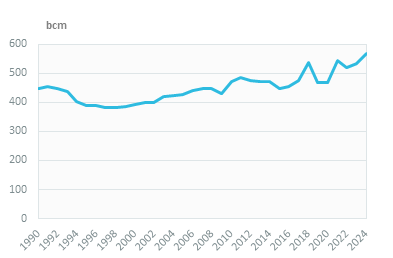
Gas consumption increased by 6% in 2024, reaching 566 bcm, after experiencing a 3% increase in 2023 and a 5% decrease in 2022. In 2021, it rebounded by 12% after dropping by 2% in 2020. It grew by around 5%/year between 2016 and 2019.
Gas is mainly consumed in the electricity sector (35%), followed by the hydrocarbon sector ("other" with 29%), industry with 20%, and the residential-services sector with 16%.
Graph: NATURAL GAS CONSUMPTION (bcm)
Source: Russia energy report
Interactive Chart Russia Gas Production & Consumption
Source: Global Energy & CO2 data
Benefit from up to 2 000 up-to-date data series for 186 countries in Global Energy & CO2 data
Additionally, for more detailed information on the LNG trade, you can request a sample of our EMEA LNG Trade Dataset
Russia Coal and Lignite Production & Consumption
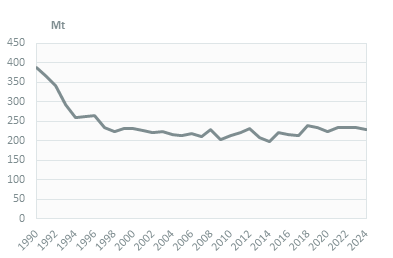
Coal and lignite consumption increased by 1.2%/year between 2020 and 2023, before decreasing by 2% in 2024 to 229 Mt. It increased by 3.4%/year between 2014 and 2019 and dropped by almost 11% in 2020.
More than half of the coal and lignite is consumed in power plants (61% in 2024) and 6% is used in industry.
Graph: COAL CONSUMPTION (Mt)
Graph: COAL CONSUMPTION BREAKDOWN BY SECTOR (2024, %)
Source: Russia energy report
Interactive Chart Russia Coal and Lignite Production & Consumption
Source: Global Energy & CO2 data
Benefit from up to 2 000 up-to-date data series for 186 countries in Global Energy & CO2 data
View the detailed consumption trends at country level (graphs, tables, analysis) in the Russia energy report
Russia Power Production & Consumption
Total electricity consumption has increased by around 3%/year since 2020, reaching 1 024 TWh in 2024. It increased slightly between 2010 and 2019 (1%/year).
Industry is the main electricity consumer with 38% of the total (stable since 2010), ahead of the residential sector with 18% (+3 pp since 2010) and services with 17% (-3 pp since 2010). Transport accounts for 6% of total electricity consumption, i.e. a significant share compared to other countries, due to the strong presence of public transport.
Graph: ELECTRICITY CONSUMPTION (TWh)
Source: Russia energy report
Interactive Chart Russia Power Production & Consumption
Source: Global Energy & CO2 data
Benefit from up to 2 000 up-to-date data series for 186 countries in Global Energy & CO2 data
View the detailed consumption trends at country level (graphs, tables, analysis) in the Russia energy report
Russia Renewable in % Electricity Production
The Government target for 2020 of a 2.5% share of wind and solar in the power mix (State Programme on Energy Efficiency and Energy Development, 2014) was not reached (0.3% in 2020). In 2021, the authorities announced plans to award RUB 360bn (US$4.9bn) of state support for renewable projects through 2035, with the aim of adding 12 GW of renewables by 2035. In 2021, the Ministry of Energy announced that it will seek to increase the share of renewables to 31.5% of the power mix by 2050 (of which 19% from hydropower, and 12.5% from wind and solar).
Source: Russia energy report
Interactive Chart Russia Share of Renewables in Electricity Production (incl hydro)
Source: Global Energy & CO2 data
Benefit from up to 2 000 up-to-date data series for 186 countries in Global Energy & CO2 data
Russia GHG emissions and CO2 emissions
Inits first NDC (2020), the country set the target to cut GHG emissions to 70% of their 1990 level in 2030 to 2.2 GtCO2eq, taking into account the maximum possible absorptive capacity of forests. In 2023, GHG emissions were 14% below their 1990 level, according to EDGAR estimates, at 2.67 GtCO2eq, which represents half of the NDC objective.
Source: Russia energy report
Interactive Chart Russia CO2 emissions
Source: Global Energy & CO2 data
Benefit from up to 2 000 up-to-date data series for 186 countries in Global Energy & CO2 data
View the detailed consumption trends at country level (graphs, tables, analysis) in the Russia energy report