Iraq Key Figures
- Population:
- 46.0 million
- GDP growth rate:
- -1.6 %/year
- Energy independence:
- 100%
Data of the last year available: 2024
- Total consumption/GDP:*
- 94.7 (2015=100)
- CO2 Emissions:
- 4.07 tCO2/cap
- Rate of T&D power losses:
- 55.0%
* at purchasing power parity
View all macro and energy indicators in the Iraq energy report
Iraq Energy News
View all news, archive your new and create your own daily newsletters only on your topics/countries of interest with Key Energy Intelligence
Iraq Energy Research
Benefit from up to 2 000 up-to-date data series for 186 countries in Global Energy & CO2 data
A data overview is available in the global energy statistics app
Iraq Total Energy Production & Consumption
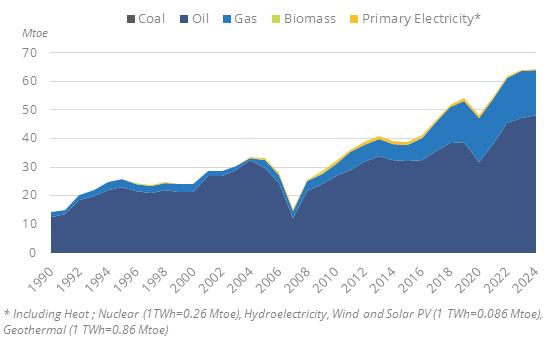
Total energy consumption has increased rapidly since 2015 (+6% per year), reaching 64 Mtoe in 2024. despite a significant dip (-10%) in 2020.
Total energy consumption per capita amounted to 1.4 toe/capita in 2024.
Graph: Primary Consumption Trends by Energy Source
Source: Iraq energy report
Interactive Chart Iraq Total Energy Production & Consumption
Source: Global Energy & CO2 data
Benefit from up to 2 000 up-to-date data series for 186 countries in Global Energy & CO2 data
View the detailed fondamentals of the market at country level (graphs, tables, analysis) in the Iraq energy report
Iraq Oil Production & Consumption
Constrained by OPEC quotas, oil production decreased by 2% and 4% in 2024 and 2023, respectively. It had previously rebounded by 10% in 2022 to 220 Mt, after remaining stable in 2021 and dropping by 14% in 2020 due to the COVID-19 pandemic. It had previously been increasing rapidly since 2010 (+8%/year), with a major boost in 2016 (+27%). This was mainly due to increased output at fields in southern Iraq and in the Iraqi Kurdistan Region, which more than offset disrupted volumes in the north.
Source: Iraq energy report
Interactive Chart Iraq Crude Oil Production & Consumption
Source: Global Energy & CO2 data
Interactive Chart Iraq Refined Oil Products Production & Consumption
Source: Global Energy & CO2 data
Benefit from up to 2 000 up-to-date data series for 186 countries in Global Energy & CO2 data
Additionally, for more detailed information on refineries, you can request a sample of our EMEA Refineries Dataset
Iraq Natural Gas Production & Consumption
Marketed gas production reached 11.3 bcm in 2024, its highest level since 2019; it grew by 30% in 2021 after a 36% decrease in 2020. It had increased very rapidly from 2015 to 2019, by 14%/year. The entire production is used domestically, mainly in the power sector.
According to the World Bank, Iraq is the third largest gas flaring country after Russia and Iran. Over the last decade, flaring steadily increased from 13 bcm in 2012 to 18 bcm in 2024 (i.e. around 12% of total global flaring).
Source: Iraq energy report
Interactive Chart Iraq Gas Production & Consumption
Source: Global Energy & CO2 data
Benefit from up to 2 000 up-to-date data series for 186 countries in Global Energy & CO2 data
Additionally, for more detailed information on the LNG trade, you can request a sample of our EMEA LNG Trade Dataset
Iraq Renewable in % Electricity Production
In 2021, the MoE announced the country's ambition to raise the capacity of clean energy to 12 GW by 2030, corresponding to 33% of the power capacity mix thanks to a sharp increase in solar capacity (5.3% in 2024, mostly hydro).
In 2017, the MoE launched the Renewable Energy Investment Program with a target of 2 695 MW of solar for 2020. The target was far from met as only around 40 MW was reached in 2020 (still 40 MW in 2024).
Source: Iraq energy report
Interactive Chart Iraq Share of Renewables in Electricity Production (incl hydro)
Source: Global Energy & CO2 data
Benefit from up to 2 000 up-to-date data series for 186 countries in Global Energy & CO2 data
Iraq GHG emissions and CO2 emissions
In its NDC, Iraq aims to cut CO2 emissions from industry by 1-2% and invest US$100bn in green economy for both private and public sectors by 2030. In addition, the NDC identified mitigation measures for the energy sector, such as reducing flaring at the oil and gas fields, switching from liquid fuels to natural gas, improving energy efficiency, and developing renewables. The initial target set in the INDC (2015) of reducing GHG emissions by up to 14% below a BaU projection in 2035 has been removed.
Source: Iraq energy report
Interactive Chart Iraq CO2 emissions
Source: Global Energy & CO2 data
Benefit from up to 2 000 up-to-date data series for 186 countries in Global Energy & CO2 data
View the detailed consumption trends at country level (graphs, tables, analysis) in the Iraq energy report